
-
Mob Justice: The Lynching of John H. Bailes in Limestone County, Alabama

After five failed attempts, the sixth delivered justice to Alice Loveless Bailes and her unborn child
The story of John H. Bailes’ lynching by an angry mob is infamous in the history of Limestone County, Alabama, but it is one that few people these days have heard of. His life took a dark turn that would end in one of the most notorious acts of mob justice the area had ever seen.
Mary Alice Loveless married John H. Bailes in the winter of 1877 when she was barely seventeen. Bailes was around five years older than his bride. Alice’s mother, her sole parent, deemed Bailes a poor choice for a husband and was dead set against their marriage. Bailes was already known throughout the community to be unneighborly and ill-tempered.
As it would turn out, Alice’s mother was right to be concerned. Within a few weeks of being wed, Bailes would become domineering and violent toward his new wife. Still, Alice tried to make the best of things and remained in the marital home, determined to make the best of her plight. It would be more than a year into the marriage before things escalated to the point that she became fearful for her life. At this point, she fled. Alice sought safety at her mother’s farm, but Bailes was not content to let her go.
An article in the Huntsville Independent dated June 5, 1879, says that on the 20th of May, Bailes visited the Loveless farm where Alice and her mother were busy working in the fields. Bailes approached his estranged wife and insisted that she return home with him. The report describes the events that followed:
“She refused, telling him that she was satisfied that she could not do so in peace and had determined not to try again. She asked him to go away and leave her in peace. He then told her that if she would not live with him, he would give her some trouble and drew a pistol and commenced firing, shooting her three times; from which she died on the following day after great suffering.”
This same article says that after shooting Alice, Bailes fled into the nearby woods and had not yet been apprehended, though “the citizens of the neighborhood of Pettusville were in hot pursuit.” Bailes was described as a white man, six feet and 160 pounds, with light brown hair and a thin brown mustache and whiskers.
The following excerpt regarding Bailes’ presence at Alice’s funeral was taken from “The Legacy” by Bob Dunnavant.
“Less than a mile from the chalybeate spring at Pettusville, where resort guests relaxed at the Pettusville Hotel and drank the health-restoring waters of the spring, a serious drama took place when on a May day in 1879, Alice Loveless Bailes and her unborn child were lowered into the grave, victims of a brutal murder at the hands of her husband, John. The cemetery is in the original Bailes Hollow situated about 100 yards north of the old Bailes home-place. Only an old chimney, almost covered by weeds, marks the spot of the house. The site can be reached either by an old road leading from the spring at Pettusville or by turning off Ragsdale Creek Road. Bob did not find John’s grave. According to the story told to Bob by his guide, Walter Sims, Bailes stood up in the woods and watched as Alice was buried. It is interesting to note that the name “Bailes” is missing from the stone. It is also interesting to speculate as to why, with feelings running so high against her murder, Alice was buried in the Bailes Cemetery.”
Around mid-June, Bailes was captured and taken to the jail in Athens, Alabama, which served Limestone County. It is interesting to note, that a report in the Athens Post on June 19, 1879, claims that Bailes wrote a letter to his jailor, Sheriff Mingea, not long after his arrest attempting to bribe his way out of jail, but the Sheriff refused as he was “not that sort.”
As the news of the murder spread, so did the outrage among the townspeople. The small communities of North Limestone County were close-knit towns where everyone knew each other, and the murder of Alice Bailes was seen as an unforgivable sin, made even more heinous by the fact that she had been pregnant with her first child at the time of her murder.
The legal system, however, was not moving fast enough for the locals. A Mongomery Advertiser article printed on the day of Bailes’ intended execution revealed that Bailes had been quickly found guilty of murder in the first degree in late July 1879 and slated for execution on September 12 by Judge W. B. Woods.
An article in the Florence Gazette on July 16, 1879, recapped the events of the court hearing, noting that Bailes “maintained a stern indifference throughout the trial, and when the verdict was read by the clerk, not a single muscle moved, or a pallor came to his cheeks.” The article further noted that the defendant seemed to be “in a great dread of mob violence, but his fears are groundless. The mob and the people are disposed, now that he is convicted, to let the sentence be carried out” despite there having been threats of vengeance from multiple people due to the horrible nature of his crime. This would change later after Bailes was successful in getting his execution delayed pending appeals.
On September 12, 1879, throngs of people gathered outside the jail. They were angered that multiple appeals had pushed the execution out to an undetermined date. They were determined to take matters into their own hands and carry it out as it had been scheduled during his first trial. Mayor J.T. Tanner had requested that the bars and saloons in the area be closed for the day to prevent trouble because there had already been four attempts by members of the community to break Bailes free from jail to hang him themselves.
According to the September 18, 1879, edition of The Athens Post, crowds gathered in smaller congregations around Athens and then made their way to the courthouse square, growing to number around 3000 by about 10 am. When Bailes requested that they give him peace to write one final letter to his mother, they even retreated for a while to allow him to do so. However, an hour later, they surged forth once again.
The leaders of the group demanded the keys to Bailes’ cell from the sheriff, but he refused. The crowd produced a variety of tools that included crowbars, hatchets, picks, saws, and sledgehammers. They used them to pry away a portion of the roof and knock out a barred window to gain entrance. Once inside, the angry mob set to work breaking through the bars of Bailes’ cell. On the advice of other officials, the sheriff relented and gave them the keys to the cell.
Bailes was hoisted from the jail and placed on a wagon by the crowd. They drove him to a spot they had designated about a mile north of town and pulled the wagon beneath a tree. A cotton rope was secured around this neck and fashioned to the tree for his hanging. Bailes made a final request that a local dentist named W.R. McWilliams might pray for him before his death.
Dr. McWilliams agreed to do so, but only after saying a few words of his own. He told the crowd that though he had no sympathy for the prisoner, they should consider moderation and let the laws take their course rather than taking matters into their own hands. Once he was finished, he said a short prayer for Bailes and stepped down from the wagon.
Though Bailes then spoke a few words himself, they were not recorded. Instead, they were drowned out by chants of “Hang him. Hang him!” However, now that the moment had arrived, it seemed that no one was willing to step forward and lynch Bailes. They were convinced to let him return to jail instead. It was at this point that the crowd abated and allowed the Sheriff to retake custody of Bailes. He was returned to jail to await the outcome of his Supreme Court appeal.
Nearly a year would pass while Bailes continued to seek new trials and file appeals, delaying his execution indefinitely. After he had been successful at getting his case moved on to the Supreme Court on technicalities twice, people were growing angrier that Bailes had not been executed for his crime. Many feared that he might even get away with the horrible murder he had committed.
According to an August 14, 1880, article in the Alabama Beacon, on the night of August 7, 1880, the collective anger reached its boiling point. It had been only a few days since Bailes’ last guilty verdict had been reversed.
At around 10:30 that evening, an angry mob of over 40 men “supposed to be from Tennessee” gathered outside the jail. Fueled by rage and a desire for immediate justice, they had devised a plot to retrieve Bailes from custody and execute him themselves.
An article in The Tennessean dated August 10, 1880, describes the events of that night.
“The crowd came in very quietly and approached the jail without noise. Some three or four then knocked at the door, and after awakening the jailer, told him they had a prisoner and showed a man with his hands tied behind him, who, they stated, was a notorious horse thief and bad man. The jailer, being satisfied that all was regular and fair and not suspecting anything wrong, went upstairs with them to the jail proper, they holding the pretended prisoner with apparent great care.”
The article goes on to say that once the jailer had unlocked the outer doors and the cell corridor doors, the men brought the prisoner inside. He instructed them to wait, as he needed to search the prisoner. It was then that a larger crowd of men rushed in, pulled out their pistols, and demanded that Bailes be turned over to them. The jailer protested, telling them they had no right and that he would not have let them in had he known their intentions, but they overpowered him and unlocked Bailes’ jail cell to retrieve the prisoner.
According to the article, Bailes attempted to fight the men off, “fighting manfully” and getting in some substantial licks while trying to flee, despite having six of the men hanging on to him. “With almost superhuman strength” Bailes advance eight or ten feet before being rushed by other members of the mob. The men brought him down from the jail to “an old, crooked locust tree” standing just inside the southwest corner of the courthouse yard. The men strung Bailes up using an old plow line fashioned into a noose, looped it over a branch, and then tied the other end to the trunk of the tree so that Bailes hung about a foot above the ground.
Afterward, the men jumped onto their horses, rode to the northeast corner of the square, and then doubled back to pass by Bailes’ hanging body. They fired off about eight pistol shots, shouted in victory, and rode north away from the scene. John H. Bailes was dead, his corpse left hanging from a tree on the courthouse square.
Surviving family members have noted that these men were not local citizens, but members of the Ku Klux Klan that had formed in nearby Pulaski, Tennessee on a late spring day in 1866. It is unknown how they came to be involved, but it is possible that members of the community enlisted their help with a task they had not been able to complete themselves.
After the men were gone, Bailes was cut down and brought into the courthouse where he was delivered to the care of the local coroner. A messenger was sent to notify Bailes’ mother the following morning but he returned to inform the coroner that she was very ill. The coroner placed her son’s body in a wagon and took him to her house for burial. He was laid to rest in Bailes Cemetery among other family members, including the wife he murdered.
A Coroner’s Jury finding reported in the Athens Post on August 12, 1880, says that an inquisition conducted in the Limestone County Courthouse on August 8, 1880, concluded that at around 11 pm on the previous night, Bailes met his death by strangulation from a rope that was tied around his neck and then attached to a tree, suspending his body in the air.
The death inquiry also notes that the jury was unable to identify the individuals responsible for tying the rope and hanging Bailes, despite diligent efforts to do so. However, the jury determined that the unknown individuals intentionally and unlawfully killed Bailes, which they describe as a felonious and willful act of murder, violating the peace and dignity of the State of Alabama.
The hanging of John H. Bailes was not just a punishment for a crime; it was a manifestation of the community’s collective outrage and their ultimate rejection of the legal process. This act of vigilante justice reflected the turbulent social dynamics of the time, where law enforcement was often seen as inadequate in dealing with severe crimes, especially those that deeply offended the community’s moral sensibilities.
This episode remains a significant part of Limestone County’s history, a sobering reminder of how easily justice can be overtaken by anger and a thirst for retribution. The story of John H. Bailes and the mob that ended his life is preserved in local historical accounts of Limestone County as a tragic piece of the county’s past.
-
Has the Long Island Serial Killer Finally Been Found?
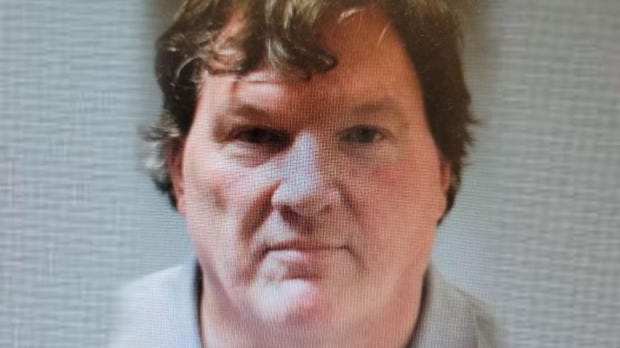

Subscribe to continue reading
Subscribe to get access to the rest of this post and other subscriber-only content.
-
Most Wanted Fugitive “El Gato” Arrested in 2013 Southlake Murder for Hire Case

Juan Jesus Guerrero-Chapa and his wife were shopping in downtown Southlake, Texas on May 22, 2013, when violence erupted. Guerrero-Chapa, a Mexican defense attorney, was sitting in the passenger seat of their Range Rover. His wife had finished placing her shopping in the back of their vehicle and was approaching the driver’s side to leave the busy upscale shopping center.
Two men, Mexican assassins known only as “Clorox” and “Captain”, pulled up behind the vehicle, blocking it in. One of them exited and approached the side of the vehicle, shooting Guerrero-Chapa multiple times through the passenger side window. Afterward, the masked man returned to the vehicle and they both fled the scene.
Photo of the bullet holes left in passenger window (Photo: FBI) Guerrero-Chapa was pronounced dead upon arrival at the local emergency room. He had been a private attorney hired to represent Osiel Cardenas. Cardenas is the former head of the notorious Gulf Cartel in Mexico who had been acting as an informant for the U.S. government.
An investigation led by the FBI Dallas Field Office uncovered information that the victim had been targeted by a group that had been stalking him since March 2011. Members of this group were seeking to kill the victim as part of a murder-for-hire plot instigated by Jose “El Gato” Rodolfo Villarreal-Hernandez, who appears to have had a long-term personal grudge against the victim.
Villarreal-Hernandez’s brother Ramon, reported to be a former financial head of the Beltran Leyva cartel, was arrested on a charge of murder-for-hire in relation to the execution of Guerrero-Chapa by Mexican authorities in 2018. He was extradited to the U.S. to face charges in 2020. He pleaded guilty last year as part of a plea bargain with prosecutors who agreed to reduce his charges and sentence him to 10 years in prison.
In 2016, three additional men were also convicted on charges related to the murder. These men had been actively tracking Guerrero-Chap and his family for months using various tech, including remote-controlled cameras and GPS devices to watch the family’s vehicles and home.
A federal arrest warrant was issued for Villareal-Hernandez in 2018 for interstate stalking and conspiracy to commit murder-for-hire. He was also placed on the FBI’s Most Wanted list. A $1 million reward was offered for information leading to his arrest.
On January 7, 2023, Villarreal-Hernandez was located and arrested by Mexican authorities.

Jose Rodolfo Villarreal-Hernandez (Photo: FBI) “Jose Rodolfo Villarreal-Hernandez is charged with orchestrating a brutal murder that took place in broad daylight at a busy shopping center. The shooter and his accomplices showed no regard for the victim, his wife, or the innocent bystanders who witnessed the murder. The FBI’s ‘Ten Most Wanted Fugitives Program’ allows us to bring this case to the eyes and ears of citizens around the world. We will not rest until Villarreal-Hernandez is apprehended and made to answer for these charges in court.” – FBI Special Agent in Charge DeSarno
Special Agent Gary Koenig with the FBI Dallas Field Office had been investigating Villarreal-Hernandez since the murder occurred in 2013. He stated that “the fact that Villarreal-Hernandez was willing to send people to the United States to track someone within the United States and then execute that person in a neighborhood in Texas—we need to set the example that this will not be tolerated.”
In addition to the murder-for-hire plot, Villarreal-Hernandez played a key role in drug trafficking from Mexico to the United States and is linked to nearly a dozen murders in Mexico, making his capture important for both countries. Koenig noted that he is “ruthless” and bringing him to justice will continue to be a top priority for authorities in Mexico and the United States.
-
Alabama Hopes to Shift Method of Execution from Lethal Injection to Gas Chamber

The Holman Correctional Facility (HCF) execution unit in charge of executing Alabama death row inmate Joe Nathan James Jr. had only one job and it didn’t go well. After multiple failed attempts to insert the needles that would carry a toxic cocktail that would end James’ life, the team opted to slice into his arm in search of a viable vein. After a three-hour delay, they finally ended the convicted murderer’s life on July 28, 2022.
James had received a death sentence for the 1994 murder of his former love interest, Faith Hall. According to court documents, James entered Hall’s Birmingham, Alabama, home by force on August 15, 1994. Once inside, he accused her of having been unfaithful and shot her multiple times. He was convicted by a jury in Jefferson County, Alabama, in 1996. They recommended the death penalty and the judge agreed. However, the conviction was overturned by an Alabama appeals court based on claims that the judge admitted certain police reports into the record in error. James was once again brought to trial, convicted, and sentenced to death in 1999.
Despite the difficulties with this July execution, the state moved forward with the scheduled execution of HCF inmate Alan Eugene Miller on September 22, 2022. Once again, the execution unit had trouble locating two veins where they could place the necessary needles. Over the course of an hour, Miller was repeatedly pierced with needles and even left hanging vertically at one point. However, unlike the James execution, the execution unit was not eventually successful. Instead, the state placed a stay on Miller’s death until he can be executed by other means.
Miller is now back on death row awaiting execution for gunning down co-workers 32-year-old Lee Holdbrooks and 28-year-old Scott Yancy at his place of employment and then driving to his former employer’s location to kill his ex-supervisor, 39-year-old Terry Jarvis. Miller had worked as a truck driver for both businesses and was known to have frequent arguments with his co-workers over his belief that others were being given better routes.
Still, the State of Alabama was not yet willing to call it quits. Kenneth Eugene Smith remained scheduled to die by lethal injection on November 17, 2022. After multiple piercings with needles in an attempt to strike the appropriate veins, the execution team was forced to call off the execution and return Smith to death row.
Smith had been sentenced to death for his part in the 1988 murder-for-hire plot in which he and another man killed Elizabeth Sennett. Sennett’s husband, a Church of Christ minister in Sheffield, Alabama, had hired his tenant to murder his wife for $3,000 so that he could collect the insurance money to pay off his massive debts. The tenant gave Smith and another man $1,000 each to commit the brutal murder and stage it as a home invasion. The crime was featured on the TV series, American Monsters in an episode titled Take Me to the River in 2018.
Only after this third attempt was the State of Alabama willing to admit they had a problem. Four days after Smith’s botched execution, Governor Kay Ivey put a halt to all executions in the state while the situation could be investigated.
Now, the state is looking to abandon executing prisoners by lethal injection altogether. Legislation passed in 2018 would allow the Alabama Department of Corrections (ADOC) to take a page from the past where some states placed the condemned prisoner into a small gas chamber that could be filled with cyanide gas. This method of execution caused death due to the damage the gas inflicts on internal organs but took longer than was deemed humane. However, rather than using cyanide, the state wants to use nitrogen gas. As oxygen is slowly depleted by the nitrogen gas, hypoxia would occur, resulting in death.
This method of death by nitrogen-induced hypoxia was envisioned by Stuart Creque. In 1995, Creque authored an article in which he speculated that the death afforded by this type of execution would be easy and comfortable for the prisoner. His writings on the subject were published in the National Review. The Oklahoma state legislature agreed, passing a 2014 bill that allowed for this method of execution as an alternative to lethal injection. Mississippi passed a similar resolution in 2017 and Alabama did the same in 2018. Several other states have earlier lethal gas legislation in place that would also allow for this type of execution.
However, Alabama seems to be the first to look into actually putting a nitrogen gas chamber into place as a means of prisoner execution. While the investigation into the failings of their lethal injection is still in process, Alabama Attorney General Steve Marshall has already issued a statement assuring the public that Alabama will resume executing prisoners as quickly as possible.
His announcement follows an episode in which Deputy Attorney General James Houts presented a prototype gas mask during a deposition with Alan Eugene Miller and asked if they would allow it to be placed on his face by prison officials for the purpose of execution. It was intended that Miller would be executed by nitrogen gas but when the time came, the state was not prepared to do so and opted to attempt the lethal injection that failed.
The display did shed some light on some of Alabama’s intended methodology. To use a mask such as the one presented, they would need to take numerous safety precautions for the execution team. Nitrogen is a dangerous gas that could expose more than just the prisoner to death if not utilized properly. It would still require the use of a confinement chamber to protect others but the delivery system would be more direct through the tubing entering the mask.
Other pitfalls to achieving this type of execution system also exist. Protests from religious organizations have already caused at least one firm hired to help streamline a safe delivery system to end a contract with ADOC. Industrial gas giant Airgas has also indicated that they have no desire to provide gas that would be used for human executions, stating that it isn’t consistent with the values they hold as a company.
For now, it would seem that Alabama is at a loss when it comes to executions. With protests, pushback from providers, and a shortage of suppliers willing to accommodate their nitrogen needs, the state’s push to become the first state to put this method of execution into place doesn’t seem as viable as they perhaps thought.
However, it doesn’t seem the state is ready to throw in the towel just yet. According to the Death Penalty Information Center, Alabama has executed 70 prisoners since 1976. 170 inmates remain on death row awaiting execution and the state is determined to carry out their death sentences in one way or another.
-
Former Virginia State Trooper Allegedly Murdered Mother and Grandparents of Teen He Catfished Online and Abducted

A former Virginia State Trooper has been shot by police officers in San Bernardino, California, after allegedly murdering the mother and grandparents of a teenage girl that he catfished on social media. Twenty-eight-year-old Austin Lee Edwards is believed to have driven from Virginia to California to meet the girl after extensive conversations online.
Police believe that after killing the girl’s family members on November 25, 2022, Edwards set fire to their Riverside home and forced the teen to leave with him. He was subsequently located by deputies from the San Bernardino County Sheriff’s Department (SBCSD). The suspect opened fire on responding officers and was shot dead when they returned fire. The teen was physically unharmed in either altercation and has been taken into protective custody by the Riverside County Department of Public Social Services.
An investigation has begun into the events that led to the deaths of 38-year-old Brooke Winek and her parents, 69-year-old Mark Winek and 65-year-old Sharie Winek, and the abduction of the unnamed teenage girl.

Mark and Sharie Winek 
Brooke Winek Law enforcement officials say that Edwards misrepresented himself to the teen girl in online chats, eventually obtaining her personal information and deciding to drive more than 2,000 miles to meet his victim in person at her home in the 11200 block of Price Court, Riverside, California. Officer Ryan Railsback told reporters:
“We had a grandmother, grandfather, and a mother of this teen murdered by this suspect who traveled from across the country for, most likely the sexual exploitation of this teenager.”
Police were called to the scene of the crime shortly before eleven a.m. on Friday for a welfare check. A neighbor had reported that the teen appeared “distressed” while getting into a red Kia Soul with a strange man after what appeared to be a dispute between the two. As officers arrived on the scene to investigate the first report, additional reports began coming in about a fire only a few houses down the street.
Upon entering the home, first responders with the Riverside Fire Department discovered the bodies of the three adults in the entryway and determined they had been the victims of a homicide. The victims were moved outside before attending the fire, which appeared to have been set intentionally. Though the home was not destroyed, it sustained significant damage to the roof and parts of the interior.

Arial View of Damage to Winek Home (Photo: KBRC) Speaking with witnesses and neighbors, the police quickly discovered that the teen they had been sent to check on also lived in the house. They began an immediate search for her and the vehicle she had been seen entering, notifying law enforcement departments in the surrounding area to be on the lookout for the teen and her kidnapper. Within hours, Edwards and the victim were located in nearby Kelso and brought to a stop by officers. When he opened fire on them, they returned fire and he was fatally struck by at least one bullet.
Police report that Edwards drove from his home in North Chesterfield, Virginia, to Riverside, California, and parked in the driveway of a neighboring home before walking to the teen’s address. Upon arriving at the home, Edwards murdered the girl’s mother and grandparents before setting the house on fire and leaving with the frightened teen. Details of how the victims were murdered or how the house fire was started have not yet been released.
A statement from Police Chief Larry Gonzalez is as follows:
“Our hearts go out to the Winek family and their loved ones during this time of tremendous grief, as this is a tragedy for all Riversiders. This is yet another horrific reminder of the predators existing online who prey on our children. If you’ve already had a conversation with your kids on how to be safe online and on social media, have it again. If not, start it now to better protect them.”
Edwards entered the police academy on July 6, 2021, and graduated as a state trooper on January 21, 2022. He was employed in the Richmond Division and assigned to Henrico County until he resigned from his post on October 28, 2022, according to Virginia State Police Public Relations Manager, Corinne Geller. It is unclear why he resigned and no reason has yet been given by the authorities. He had also worked for the Washington County Sheriff’s Department in Virginia.
Austin Lee Edwards (Photo: Riverside Police Department) Brooke Winek was a beloved single mother to two teenage daughters. Mark Winek had been a girls’ softball coach at Arlington High School for years. He and his wife, Sharie, were known to help others out in any time of need. They were well-loved by family and friends in their community, who describe them as “selfless” and “caring.”
The Wineks are survived by Mark and Sharie’s oldest daughter, Shelli, and Brooke’s two daughters. A Go Fund Me has been set up to assist the family with funeral expenses and help support Brooke’s two daughters as they recover from this tragedy. As details continue to emerge on this tragedy, family, friends and the entire community mourn this senseless loss of life. Law enforcement continues to investigate the series of events that led to the murders and abduction.
-
Australian Woman Decapitates Mother During Heated Argument

Twenty-five-year-old Jessica Camilleri lived in the St. Clair community of western Sydney, Australia, with her 57-year-old mother, Rita Camilleri. On July 19, 2019, the pair got into an argument that ended with Jessica decapitating her mother in front of a four-year-old boy present in the home.
The young boy was Jessica’s nephew. Rita had been babysitting for her sister when the incident occurred. He is believed to have witnessed the events that took place and was also injured in the altercation, suffering a minor head injury. He was treated and released at Westmead Children’s Hospital. Camilleri was later arrested in the front yard of their neighbor’s house and charged with murder.
According to Nepean Police Area Commander Detective Superintendent Inspector (CDSI) Brett McFadden, the scene was one of the “most significant, most horrific scenes police have had to face.”
In her first appearance in court after the murder, Camilleri stated that she was unable to properly move her fingers to remove the blood from them after the attack. Her attorney indicated that Camilleri had multiple mental health concerns and didn’t request bail. She was ordered to undergo a psychological evaluation before her next court date.
Jessica stood accused of stabbing her mother more than 100 times and gouging out her eyes after flying into a fit of rage as the two argued. She then took her mother’s decapitated head outside and set it down on the sidewalk. Neighbors contacted the police to come to the scene. Jessica did not attempt to flee, instead waiting for them to arrive. Included in a report from 7News, is audio of Jessica speaking to first responders:
During the trial, it was revealed that Jessica had asked officers reporting to the scene whether doctors would be able to sew her mother’s head back on. When an officer told her that “was a bit of a stretch,” she then asked:
“So, there’s nothing that can be done to bring her back?”
Court testimony revealed that Jessica had suffered from behavioral, social, and learning disabilities, including ADHD, since childhood. After the attack, she was also diagnosed with multiple psychological impairments, including autism spectrum disorder, intermittent rage disorder, and anxiety.
Jessica had a history of violently attacking people, including strangers and relatives. Rita was designated as Jessica’s caregiver but dismissed Jessica’s increasingly alarming behavior before the attack to protect her daughter. Jessica had stopped taking her medications at least three months before the attack in favor of attempting more natural remedies.
In an interview with detectives on the night of the murder, Jessica said that she had gotten into an argument with her mother about entering residential mental health care. She said that her mother had attempted to dial Triple Zero for them to take her and Jessica knocked the phone out of her hands. Her mother then attempted to locate another phone in the house. Jessica claimed that when her mother failed to find another phone, she grew enraged and grabbed hold of her hair, dragging her to the kitchen.
According to Jessica, she then grabbed a kitchen knife and stabbed her mother. Rita was alive long enough to sustain over 90 defensive wounds as her daughter continued to retrieve knives to stab her. Before the assault ended, Jessica had employed seven different knives, breaking off four of them due to the force of her attack. She focused on her mother’s head and face, leaving behind more than 100 knife wounds. When it ended, she removed her mother’s eyes and took her dismembered head outside, where she placed it on the sidewalk.
The prosecution in the case contended that Jessica’s love of horror movies contributed to the deranged thought process that led to her mother’s stabbing and beheading. Detectives had found eight copies of The Texas Chainsaw Massacre and five copies of Jeepers Creepers when they searched the home after the attack. This claim was backed up by two psychiatrists who reported that the knife attack resulted from intellectual disability and autism spectrum disorder with an unnatural fixation on graphic horror movies.
This assessment of Jessica’s characteristics stood in stark contrast to the distraught woman awaiting her fate in the courtroom. As she waited for the verdict to be handed down, Jessica seemed in danger of hyperventilating. The corrections officers that had escorted her to court had to soothe her and tell her to breathe.

Jessica Camilleri (Photo: Facebook) In her victim impact statement, Jessica’s older sister Kristi Torrisi said that the family had tried repeatedly to get help for Jessica’s behavior but that she had refused to go for any treatments offered. Meanwhile, Jessica began exhibiting an increasing tendency toward violent outbursts.
In the months before the attack, Jessica had attacked her aunt, pulled people’s hair in public, and made hundreds of threatening phone calls to strangers. She had been charged with several of the crimes but her mother had intervened as much as possible to lessen any action taken against her. Kristi told the court that their mother had believed that she could love and protect Jessica without having to jail or institutionalize her. Despite her mother’s great love for her, Kristi says that Jessica “killed and butchered her like she was nothing, all because of a fit of rage.”
Rita’s sister, Mary Hill, said that Rita had shown unconditional love for her daughter despite her troubled history which was nothing short of “remarkable.” Mary said that it was this type of hope that Rita had possessed for her daughter that had blinded her to the increasing amount of danger Jessica posed to herself and others.
Rita Camilleri (Photo: Facebook) In December 2020, Jessica was found not guilty of murder due to mental impairment. Her defense claimed she had substantial impairment by abnormality of the mind due to a loss of control. Instead, she was found guilty of the lesser charge of manslaughter. She was sentenced to 21 years and 7 months behind bars with credit given for time served from July 20, 2019. She will be eligible for parole in 16 years and 2 months.
Jessica has since appealed the sentence, her lawyer claiming that her crime had been “held against her” by Judge Wilson during sentencing. Her lawyer argues that her “loss of control” during the attack was not given full consideration.
While handing down the sentence, Justice Wilson had acknowledged the need to balance a need for punishment with sentencing a “significantly disabled offender.” Despite Jessica’s loss of control, the judge said that she still understood that was she was doing was wrong.
“The offender’s disabilities are such as to attract sympathy; her conduct is such as to attract the strongest condemnation and punishment. In light of the extreme gravity of this crime, the very great harm done, and the need to protect the community from the offender, a stern sentence is called for.”
In September 2022, Jessica’s appeals attorney, Tim Game SC, told a court that his client’s disabilities border on mental illness, and that was not reflected in her sentence. Game said that Justice Wilson had made a mistake in focusing on whether Jessica understood her actions instead of accepting the testimony of the two psychologists who determined that she had experienced a “loss of control for the duration of the attack.”
Though Game agrees that Jessica did understand that what she had done was wrong, he claims that the judge essentially said, “you’re very lucky you’ve got manslaughter” and then held the fact that she’d been found guilty of lesser charges against her. He said that Jessica should have even been given further consideration in sentencing because she had offered to plead guilty to manslaughter before trial and been denied that option
Attorney Game further points out that there has been a marked improvement in Jessica’s recent conduct after being moved to a new prison. However, before that change, Jessica had a number of violent encounters as cataloged in an article printed by the New Zealand Herald. Whether her improved behavior is due to a true change in behavior or a result of preventative measures is currently unclear.
Crown prosecution has continued to argue against the appeal, claiming that Justice Wilson had every right to impose a heavy sentence given the gravity of the crime. They say that, if anything, Jessica’s disability had benefited her in sentencing, as it was likely all that prevented her from getting the maximum term allowed. They point to a line in the final judgment that says:
“As I observed at the outset, this is as serious an example of manslaughter as it is possible for such a crime to be.”
It remains to be seen how the court will rule. They have reserved their decision and will hand it down when they have finished weighing the merits of the appeal but it could be decided before the end of the year. Even if her sentence is further reduced or even overturned, she has incurred additional charges for attacks against other inmates while incarcerated that will likely prevent any immediate release. See more details here.
The one clear thing is that Jessica Camilleri will continue to be a danger to society if not monitored closely once released. Her family has indicated that none of them are willing to forgive her for her actions and will not be taking her in when she is released. The one person willing to help Jessica lost her life to her daughter’s mental illness. So, it remains to be seen how Jessica can be safely released when and if the time comes.
Sources: ABC, New Zealand Herald, 7News, The West, Twisted Minds
-
State of Alabama vs Brittany Smith: A New Netflix Documentary

State of Alabama vs. Brittany Smith, directed by Ryan White and produced by Jessica Hargrave begins streaming on Nov. 10, 2022. According to Netflix, the documentary tells the “harrowing story of a woman trying to use Alabama’s Stand Your Ground law after killing a man she says brutally attacked her.”
***
In 2018, Brittany Smith shot and killed a man she says attacked and raped her in her Stevenson, Alabama, home. Now, her story is being covered in a Netflix documentary titled The State of Alabama vs. Brittany Smith. Director Ryan White, widely noted for his documentary, The Keepers, details the case against Brittany, an Alabama mother struggling to get her life in order when she finds herself in a situation that ends in tragedy.
When Brittany Smith shot Todd Smith (no relation), a former acquaintance she had known in her teens, she and her brother were trapped in her house with him. According to court records, Todd had a long history of violence and assaults, including numerous attacks on his ex-wife and other partners. Over the span of two decades, Todd had been arrested over 70 times for various violent crimes and domestic assaults. In the hours leading up to the shooting, Smith had told Brittany that he would kill her if she called the police.
In most circumstances, a person who kills someone while being attacked by that person in their home would be covered by Alabama’s “stand your ground” defense. Many people in this situation would never be charged. That was not the case with Brittany, due at least in part to her brother’s arrival on the scene to help her and a subsequent scuffle between him and Smith. When Brittany acted to protect herself and her sibling, she was charged with murder and sent to jail to await trial.
Journalist and executive producer of the Netflix documentary, Elizabeth Flock, has followed Brittany’s story since shortly after the young mother’s not-guilty plea. According to Flock’s research, women are much less likely to use “stand your ground” laws successfully.
Flock began filming Brittany’s journey shortly after they met and continued to do so throughout the trial and beyond. At one point, Brittany was offered a 25-year sentence in exchange for pleading guilty but she refused, insisting that she had done nothing wrong and wouldn’t willingly go to jail for protecting herself from harm.
Eventually, Brittany gave in and changed her plea to guilty, accepting a 20-year sentence instead. She would ultimately be sentenced to 18 months, which was reduced further by time already served—she had spent year behind bars awaiting trial. Her sentence included a further 18 months on house arrest upon her release.
Even Todd Smith’s cousin, Jeff Smith, seemed to understand the injustice of the charges against Brittany. According to Flock, Jeff had come into the courtroom with a deep resentment for the woman who had shot his cousin. However, after seeing the testimony of a nurse examiner who detailed all of the injuries Brittany had suffered during the attack and rape that led up to the moment when she shot her attacker, he began to see her as the victim she clearly was. He even penned a note to Smith, offering her his apologies.
Before the attack, Brittany had a history of methamphetamine abuse, something she had overcome. She was in active recovery and had recently been approved for further visitation with her children, whom she’d lost custody of during her dark days of addiction. The children had been staying with an uncle during the course of her trial.
Whatever the public may think of Brittany’s personal choices, it does not change that she was attacked in her home and acted out of self-preservation. Many have a tendency to view her as less of a victim because she had her own faults. Statistically, it was already pre-determined that she, as a female, would be viewed far more harshly than a male counterpart who had claimed a “stand your ground” defense. These two facts add up to what many consider persecution rather than prosecution.
There is far more to Brittany’s story. After her trial and incarceration, authorities continued to treat her in ways that many would deem unfair and harsh when compared to others in similar situations. You can read more of her story in a previous article I wrote about her case and tune in for the upcoming Netflix documentary to see the real person behind the headlines. The documentary also includes commentary from Pulitzer Prize-winning journalist Ashley Remkus of AL.com, who has followed this story from the beginning.
In the trailer for the new Netflix documentary, Brittany has this to say:
“I was arrested for murder; the man was in my home. I did what I thought I had to do because if I wouldn’t have, my brother and I would both be dead. I want to get my children back. I want them to know that mommy’s not a murderer and that mommy defended herself – and that you should always defend yourself.”
Brittany Smith is a human being, just like you or me. She is more than her demons. A woman attacked and raped in her own home is entitled to defend herself however she can. She is yet another example of a female victim being prosecuted for standing up against a rapist or abuser and a system hell-bent on putting women on trial, either figuratively or literally, when accusing a man of sexual assault.
-
Childhood Boogeyman Called “The Green Holler Mauler” Might Be Real
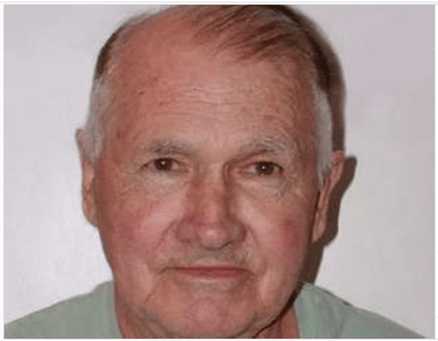
Iowa woman claims father was a prolific serial killer who murdered dozens of women
Donald Dean Studey died in 2013 at the age of 75. Now, his daughter is telling Iowa police that he may have murdered as many as 70 women. 53-year-old Lucy Studey McKiddy claims that her father forced her and her three siblings to help transport his victims across the property and hide the bodies in a 90-foot-deep well.
According to McKiddy, her father was often intoxicated and routinely murdered women by bashing them in the head inside a trailer on his property in the remote, small town of Thurman, Iowa, where his family had lived for more than a hundred years. Her reason for coming forward was addressed in a statement she made:
“All I want is to get these sites dug up, and to bring closure for people and to give these women a proper burial. My father was a lifelong criminal and murderer.”
Studey had previously been widowed by two wives who committed suicide. One died by strangulation and the other died of a gunshot wound. It is unknown at this point if either of these deaths is now being questioned.
Studey later threatened to kill the son of his second wife while experiencing a suicidal episode. According to Sheriff Kevin Aistrope, when deputies arrived on the scene, Studey shot himself in the arm. It was only one of several odd encounters with local law enforcement that resulted in any calls made to the property always being responded to by multiple officers.
Though McKiddy has given the authorities and news outlets some conflicting information, Aistrope feels that further investigation is warranted. The Fremont County Sheriff’s Office is planning to excavate a portion of land adjacent to the Studey property.

The Studey home (Photo: Google Maps) Deputy Sheriff Tim Bothwell, speaking to WHO-13, said that McKiddy had reported the same information to their department back in 2007. At the time, they had excavated a portion of the Studey land and found no evidence to support her claims. The process had cost more than $300,000. However, they have learned that there was another well on adjoining property on which a county-run home for the poor was previously located. Now, a second excavation will take place on that land located behind the Studey property.
Cadaver dogs brought out to aid the search alerted to four separate spots on the property with a strong reaction to the area surrounding the well. The FBI has also been brought in to assist the local authorities and Iowa’s Division of Criminal Investigations with the case.
McKiddy’s sister denies the accusations against their father. Susan Studey insisted that her father is innocent of her sister’s accusations. In statements to the press, she said that she is two years older than her sibling and would remember if such events had happened.
“I would know if my dad was a serial killer. He was not, and I want my father’s name restored. He was strict, but he was a protective parent who loved his children. Strict fathers don’t just turn into serial killers.’
In addition to her insistence that the allegations against her father are false, Susan Study claims that the cadaver dogs likely hit on the remains of a stillborn infant sister who was buried in a shoebox on the property and a golden retriever buried on the land rather than any victims her sister claims might be found.
Deputy Bothwell said he had also doubted McKiddy, who admitted to stealing $16,000 from her father in 2007. At that time, it was thought that her claims might be retaliation for the accusations he made against her for theft. However, Sheriff Kevin Aistrope has stated that he intends to see the case through if there might be undiscovered victims that can be recovered for their families.
“I’m not going to let it die. I’m just not gonna let that happen. We’ve got to go with Lucy. No matter if they say it’s not true or say she’s crazy or whatever they can say, we have to look into it. We have no other choice.”
Per the Des Moines Register, McKiddy had made a statement to police last year that she had heard there could be as many as 15 bodies from others but she was only personally aware of five. She told police that she and her siblings were forced to pile dirt and lie on the bodies in the well after they were deposited there.
In an interview with Newsweek, she made a statement that she had watched her father and two others removing a body from the trunk of a vehicle in 1976 or 1977. She says they put the body into a wheelbarrow and moved it to the well.
In a separate incident, McKiddy claims to have seen a dead body near an old cellar on the property and says she watched her father move the body to the well. There, she said she saw another body. According to McKiddy, her father may have killed as many as 70 people, keeping some of his victims’ gold teeth as trophies. It is unclear how she arrived at that number.
In other statements, McKiddy claimed that her father may have sexually assaulted and murdered a 15-year-old female runaway who was in the car with him in the seventies or eighties. She says the girl disappeared completely the following morning. According to McKiddy, all of the victims were dark-haired, Caucasian, and in their twenties or thirties, except for the runaway. Police believe that Studey may have lured sex workers from Omaha, Nebraska, to his five-acre property on Green Hollow Road before murdering them.

Satellite view of the remote area where the Studey home is located (Photo: Google Earth) Studey was no stranger to violence. He had repeated encounters with the police. He had a criminal history under several aliases. “Hate” and “love” were tattooed on the knuckles of either hand. Previous offenses include a stint in a Missouri jail in the 1950s for petty larceny and a drunk driving charge in Omaha in 1989. Local police admitted that they were reluctant to visit the trailer where he lived because they were wary of visiting the remote property given Studey’s erratic behavior.
Other locals say that no one goes to the remote area around the Studey property known as Green Hollow because it is known as a place where bad things might happen. Kids told one another creepy stories about a monster that roamed the woods around the Studey home. They referred to the unknown monster as “The Green Holler Mauler.” Now, locals wonder if perhaps the monster were real–none other than the reclusive Studey.
Whether McKiddy’s claims prove false or her father is, in fact, one of the most prolific serial killers in history remains to be seen.
Donald Dean Studey (Photo: FCSO) -
Boy Found in a Vegas-Themed Suitcase in April Has Been Identified

Mother Wanted on Charges of Murder
The 5-year-old boy found in a Las Vegas-themed suitcase on April 16, 2022, has finally been identified as Cairo Jordan of Atlanta, Georgia, according to the Indiana State Police (ISP). In a statement made by ISP, a warrant has been issued for the arrest of Cairo’s mother and another woman.
The suitcase containing Cairo’s body was recovered in the spring near a dead-end road in Washington County by a mushroom hunter who lived nearby. His body was found clean and clothed. His remains showed no signs of physical abuse and tests showed no foreign toxins were present. An autopsy revealed that he had died of an “electrolyte imbalance” caused by “viral gastroenteritis.” It is believed he died from dehydration due to excessive diarrhea and vomiting.
According to Mark McDonald, a Norton Children’s Hospital medical director, it is unusual for a child to die of dehydration. He says that it would have taken several days for Cairo to die, depending on the amount of fluids he was given.
Suitcase in which Cairo Jordan’s body was found (Photo: ISP) Police have arrested one suspect in the case, 40-year-old Dawn Coleman of Shreveport, Louisiana. She was taken into custody in San Francisco on October 19 and charged with neglect of a minor resulting in death and obstruction of justice. They are still looking for another suspect, Cairo Jordan’s mother.

Dawn Coleman (Photo: ISP) Cairo’s mother, 37-year-old Dejuan Ludie Anderson of Atlanta, Georgia, has not yet been located by police. She is wanted for murder, obstruction of justice, and neglect of a minor dependent resulting in death. Anderson is 5 foot 5 inches tall and weighs about 135 pounds. She has short brown hair as seen in her photo below but often wears wigs or extensions. Anderson was last seen in the area of Echo Park in Los Angeles but travels often. Recent known destinations are San Francisco, San Diego, Las Vegas, and Houston.

Dejuan Anderson (Photo: ISP) Court documents show that police were able to retrieve fingerprints from the trash bags in which the boy’s body was placed before being put inside the suitcase. The fingerprints matched those of Anderson, who had been previously arrested in South Carolina on March 12, 2022, for child endangerment, speeding more than 25 miles per hour over the speed limit, and failing to stop for police in pursuit. Anderson was finally stopped after a 30-minute chase that ended when she ran out of gas. Cairo and Coleman were also in the car. Anderson told the arresting officers that she was her sister, but police have found no proof that they are any relation.
A little over two weeks later, on March 31, Anderson was again arrested, in Louisville, Kentucky—this time for shoplifting and assault. She was accused of stealing merchandise from Oxmoor Mall and striking a security guard. She was released on April 11th pending upcoming hearings, but she never showed up for her court appearances. A bench warrant for failure to appear was issued in May.
Police were able to match photos found on Anderson’s Facebook page to autopsy photographs of the boy they found in the suitcase as a preliminary identification of Cairo. In some posts made on the platform, Anderson discussed needing to perform an exorcism on Cairo to remove “a very powerful demonic force.” One post discussed the possibility of authoring a book or making a podcast about living with a child possessed by demons. There were also photos of the same suitcase in which Cairo’s lifeless body was found abandoned on her Facebook page.

Dejuan Anderson with son, Cairo (Photo: ISP) Anderson tweeted the following to an Indianapolis minister on Twitter on April 12:
“I have survived the death attacks from my 5-year-old throughout the 5 years he has been alive. I have been able to weaken his powers through our blood. I have his real name and he is 100 years old. Need assistance.”
Dejuan Anderson on TwitterOn April 15th, the day before Jordan’s body was discovered, Anderson posted on Facebook:
“This is a whole demon in a child body. Why you think she need a cigarette?!! Losing energy huh! 64 years old in a child body. Was full of gifts and magickal (sic) rites stronger than many of you because your frequency not high enough. Start asking spirit to reveal these things to you hiding behind a body. “
Dejuan Anderson on FacebookAnderson and Coleman’s phones pinged at a cellphone tower in Pekin, Indiana, very near where Cairo’s body was found within days of these posts. Surveillance video from a nearby property owner shows the car Anderson was driving stopping on the road where the suitcase was left. Separate video from Riverlink cameras show Anderson’s car allegedly driving over a bridge from Indiana to Louisville the same day.
Neither woman is from the area where Cairo’s body was abandoned. Police believe they were passing through on their way back to either Anderson’s home in Atlanta or Coleman’s home in Shreveport.
Cairo’s father, Vincent C. Jordan, has expressed his grief at learning about the death of his son via a Facebook post.
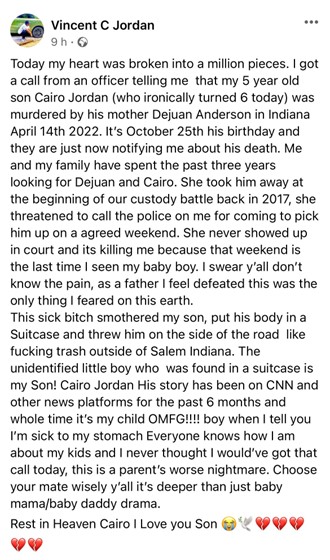
Screenshot of Vincent Jordan’s post on Facebook Dejuan Anderson is believed to still be in the Los Angeles area but could be anywhere. If you have any information about her whereabouts, please contact the Clark County Sheriff’s Office at 812-246-5424, your local law enforcement agency, or dial 911.

Vincent Jordan with son, Cairo (Photo: Facebook) -
Woman Escapes from Alleged Kidnapper’s Basement Where She Was Held Captive for Weeks

Turns out there is a potential serial killer in Kansas City, despite denials from police
For weeks, the Black community in Kansas City has complained that there was a string of Black women and girls being abducted and possibly murdered. Rumors of a serial killer have circulated and been called “unfounded” by police.
Now, a 22-year-old Black woman identified only as “T.J.” has escaped a Missouri basement where she was held for weeks as her kidnapper repeatedly whipped and raped her. T.J. made her escape on October 7 while her captor was out of the house to take his child to school. Running to a neighbor’s house, she beat on the door and pleaded for help. The woman told Ciara Tharp, the neighbor who let her in and assisted her, that she had friends that hadn’t made it out alive and claimed that the man who abducted her had killed them.
Police were sent to the residence of Timothy M. Haslett, Jr. after T.J. fled captivity in his home in Excelsior Springs. The home has now been boarded up and marked with police tape while the case is further investigated. At present, police say they are looking into the possibility of at least two more victims. According to the community, there may be more.
The Kansas City Defender has uncovered social media posts made by Haslett that reveal he is a dangerous white supremacist who believed we are in a race war and made many disturbing posts on his Facebook page.
Thirty-nine-year-old Haslett pleaded guilty last week to charges of rape, kidnapping, and assault.
Timothy Haslett, Jr. (Photo: (KCPD) Rumors had been going around social media and the community for weeks. Bishop Tony Caldwell, a community leader, was featured in a video posted by The Kansas City Defender in which he talked about the area where women had been going missing. It is the same location where the recently escaped woman said she was abducted.
In response to the rumors and Bishop Caldwell’s video, the Kansas City Police issued a statement that the claims were “completely unfounded” and insisted that there was no basis for the rumors. Now, Officer Donna Drake, speaking on behalf of the department, has told reporters that the statement was made because no formal missing person reports had been made.
The Clay County Prosecutor stated in the probable cause statement for the arrest that T.J. reported to police that Haslett held her captive in a small basement room he had built. She was secured with handcuffs on her wrists and ankles. The victim had multiple injuries on her back where she had been whipped while restrained.
When police arrived at the home of Haslett’s neighbor, they found T.J. wearing latex lingerie. She had a metal collar with a padlock and duct tape still secured around her neck. She said that Haslett had picked her up from Prospect Street in Kansas City in early September 2022. This is the same area noted by Bishop Caldwell in his video.
According to social media rumors, there are at least four Black women and three girls who have gone missing from the same area. The investigation is still in the early days. It remains to be seen how many women may have been harmed or killed by Haslett or how many might have been prevented if police had taken claims by the community more seriously instead of flatly denying their concerns while a monster roamed free.
Sources: Newsweek, Huffington Post, KMBC, Fox4KC, Kansas City Defender
Latest
1–2 minutes
 Doing Crime